Kinship Co-Op
A support network co-designed with grandmothers raising their grandchildren in Hazelwood, Pittsburgh, where neighbors trade help, care and know-how instead of money.
Designer and researcher, end to end. MDes thesis advised by Kristin Hughes.
JADA House International, the Family Center, and grandmother caregivers in Hazelwood
A year-long project, 2024 to 2025. Supported by a CMU GuSH Research Grant.
Interviews, home visits, experience and stakeholder mapping, systems mapping, a co-design board game, service blueprinting, prototyping
Grandmothers holding families together, without a system built for them
About 2.5 million children in the US are raised by grandparents or other relatives, around 500,000 of them under the age of three. Children in these "grandfamilies" are 50% more likely to face nutrition-related health problems. Most grandparents didn't expect to be parenting again, and most nutrition programs are designed around young, two-parent families.
Hazelwood, a former steel town on Pittsburgh's Monongahela River, is a recognized food apartheid zone shaped by decades of disinvestment. I started with a question about nutrition and found that food was only the entry point to a much bigger web of challenges.
Listening in kitchens and living rooms
As someone from outside Hazelwood, trust came first. JADA House and the Family Center introduced me to grandmothers, and I chose methods that let people show as well as tell.
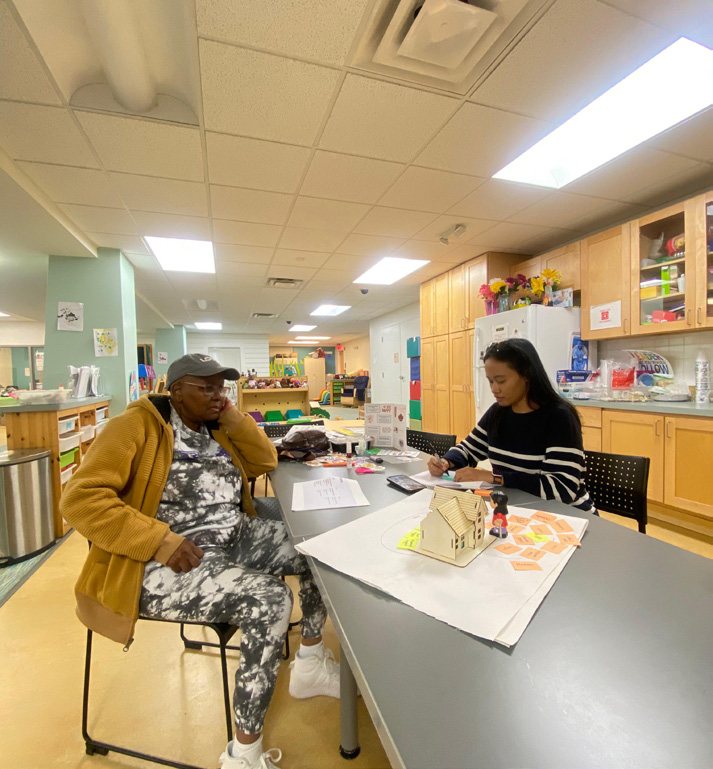
Interviews with 9 grandparents, 5 of them at home. Each built a timeline of their caregiving journey with collage images, filled in "Madlib" sentence cards about their beliefs, and mapped who they turn to for food help and nutrition advice.
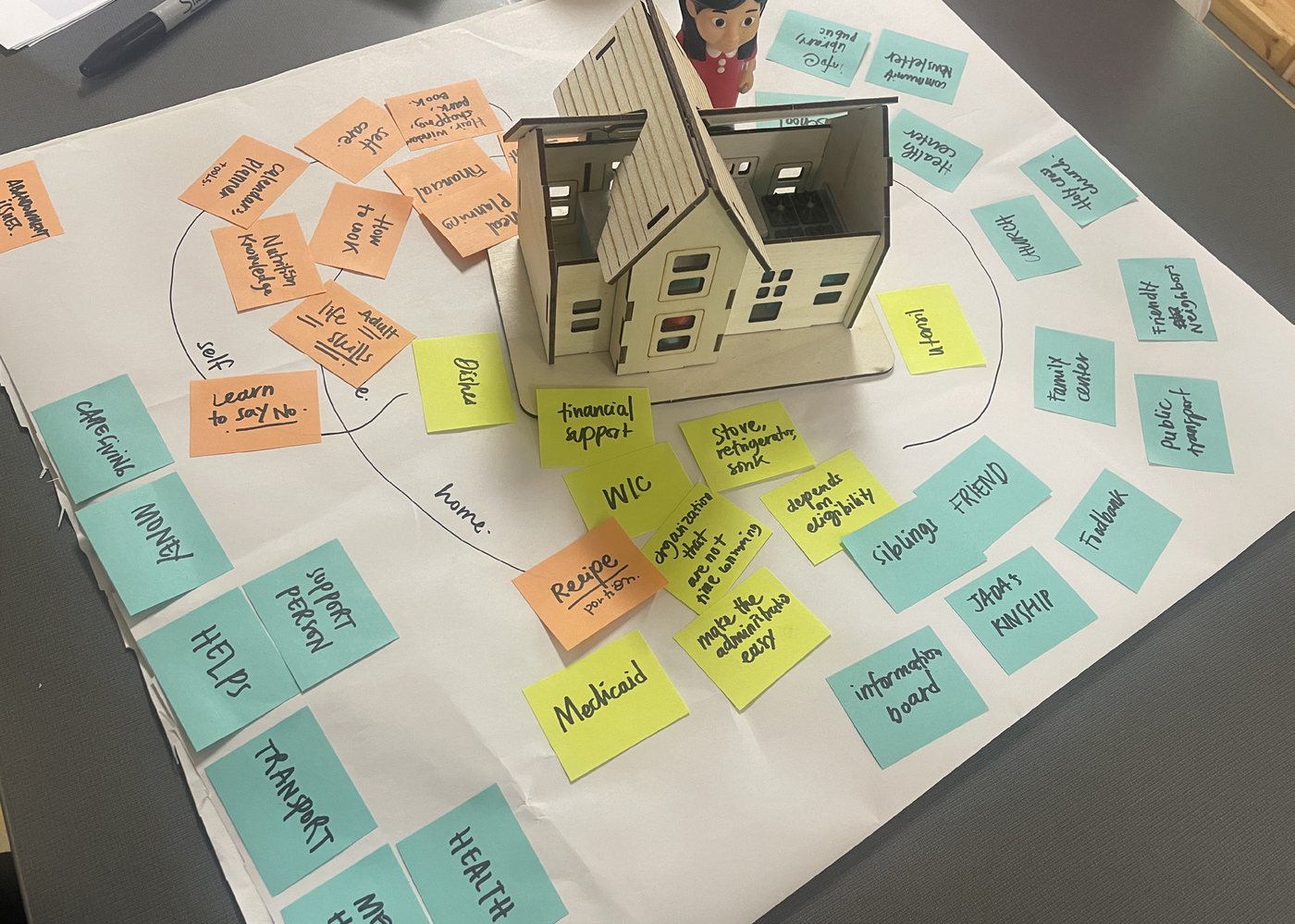
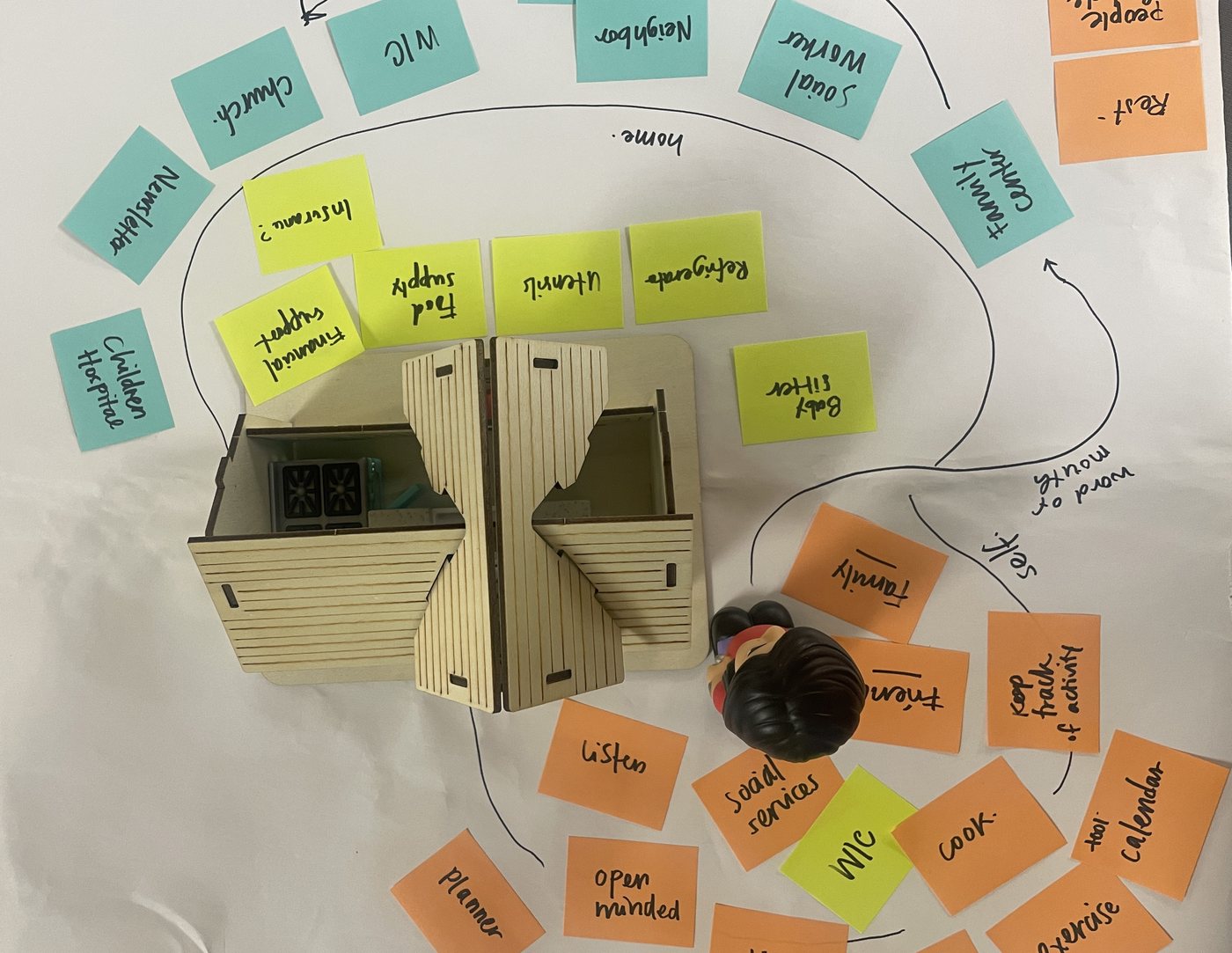
A mapping workshop with 5 grandparents around a miniature house, workshops with 2 local organizations, and 5 visits to food banks, a grocery store and nutrition programs.
"I love my granddaughter and want to give her the best food. But then she got bored, so I had to think of something. It's hard for me."
A grandmother in Hazelwood
Not a knowledge gap. A support gap.
I turned every insight into cause-and-effect links and looked for loops that keep the problem in place, using David Stroh's approach from Systems Thinking for Social Change. For example: caregiving stress leaves no time to cook, quick food affects health, and poorer health makes caregiving harder still. Four drivers kept showing up.
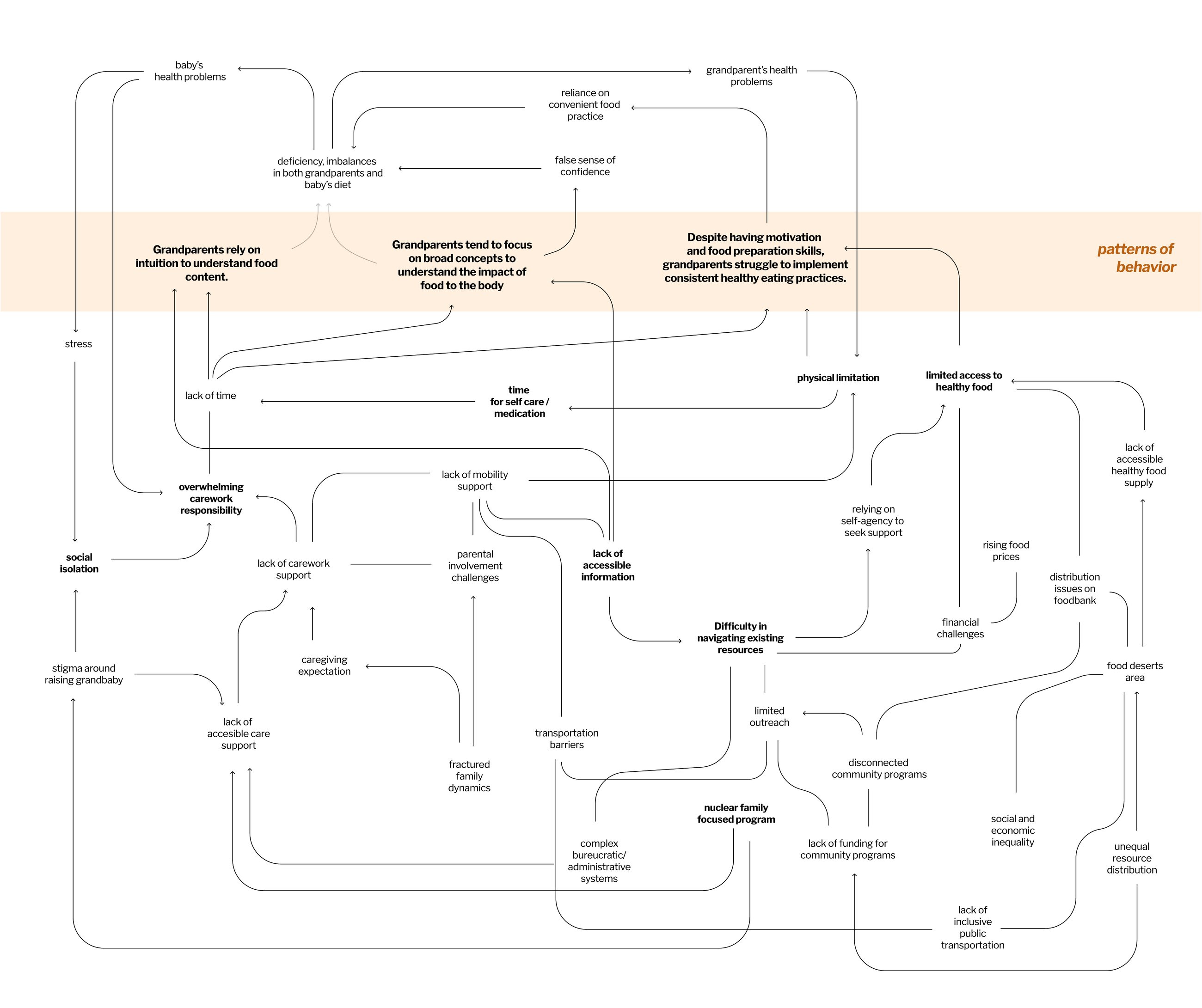
How might we design a supportive environment where grandparents can access the knowledge, resources and skills to improve how they feed their families?
Of three directions (a redesigned food bank, a friendlier grocery store, a peer support network), the support network reached deepest into the loops: it touches isolation, care work, food access and information all at once.
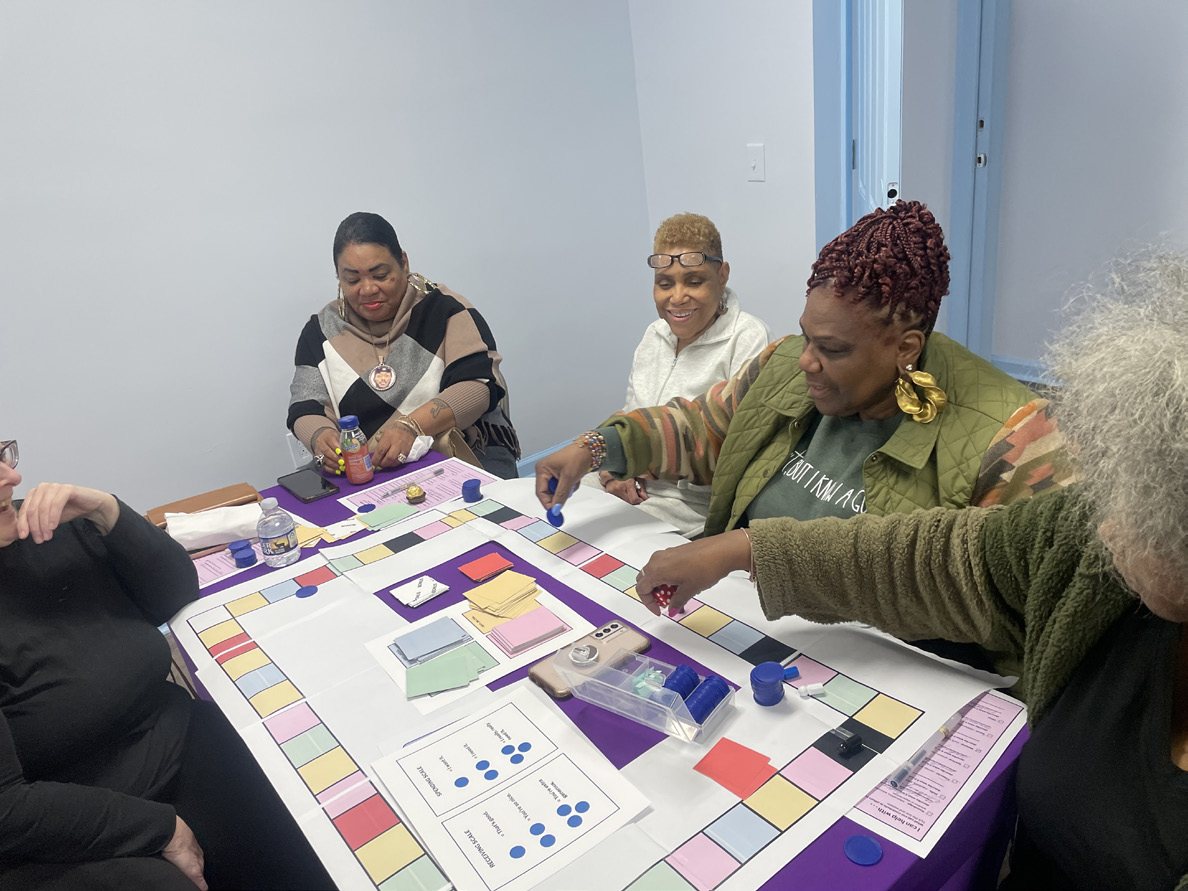
Community Exchange: a board game for imagining mutual aid
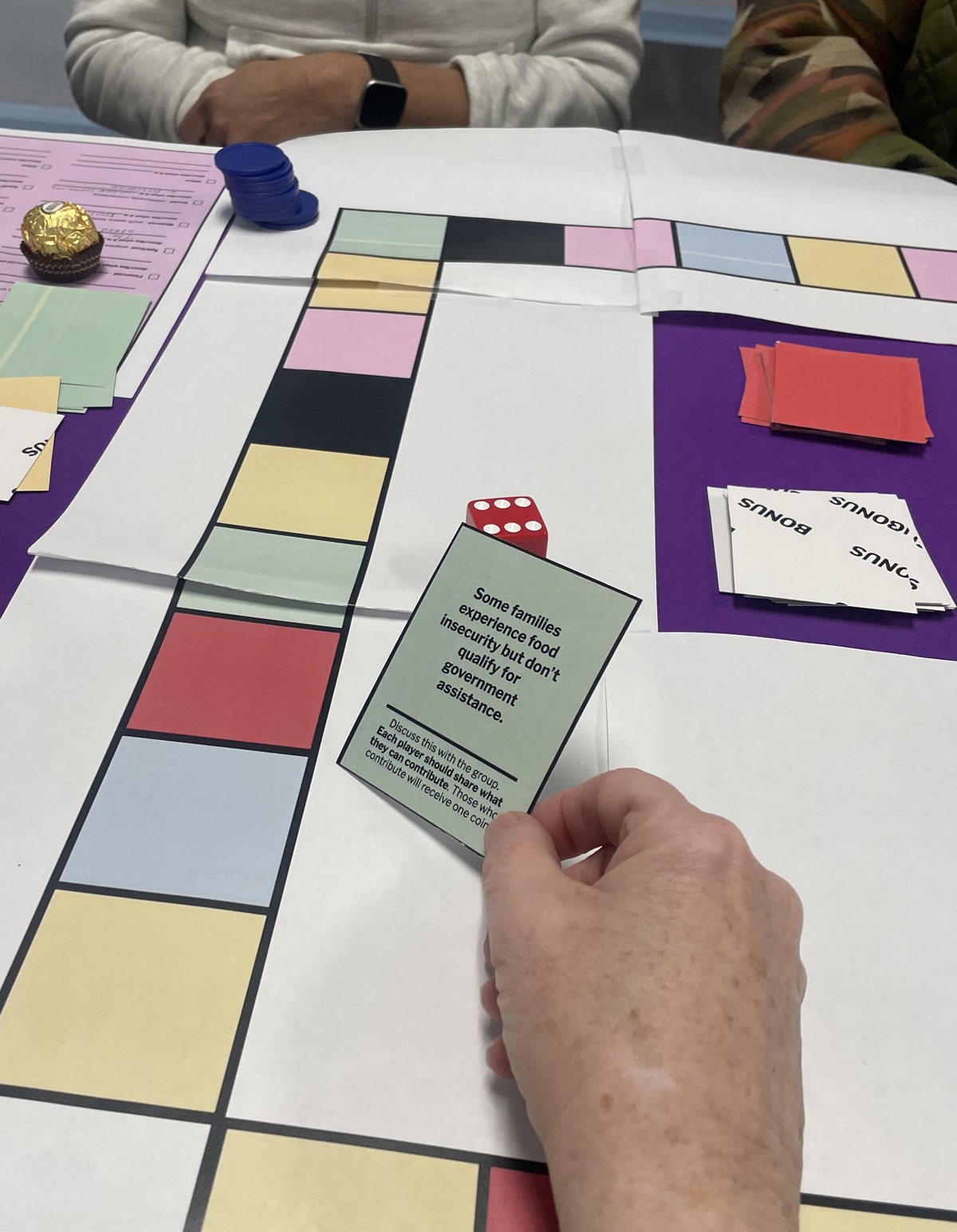
Asking a group of grandmothers "would you help each other?" gets polite answers. Playing a game gets real ones. I designed a board game where players ask for help, offer it, solve neighborhood problems together and decide what each act of help is worth, so we could see how the community values support beyond money.
Adapted from "Exchangeopoly" by Chopra, Everson and Vines (PDC 2024), a Monopoly-inspired game for exploring value exchange in post-industrial communities.
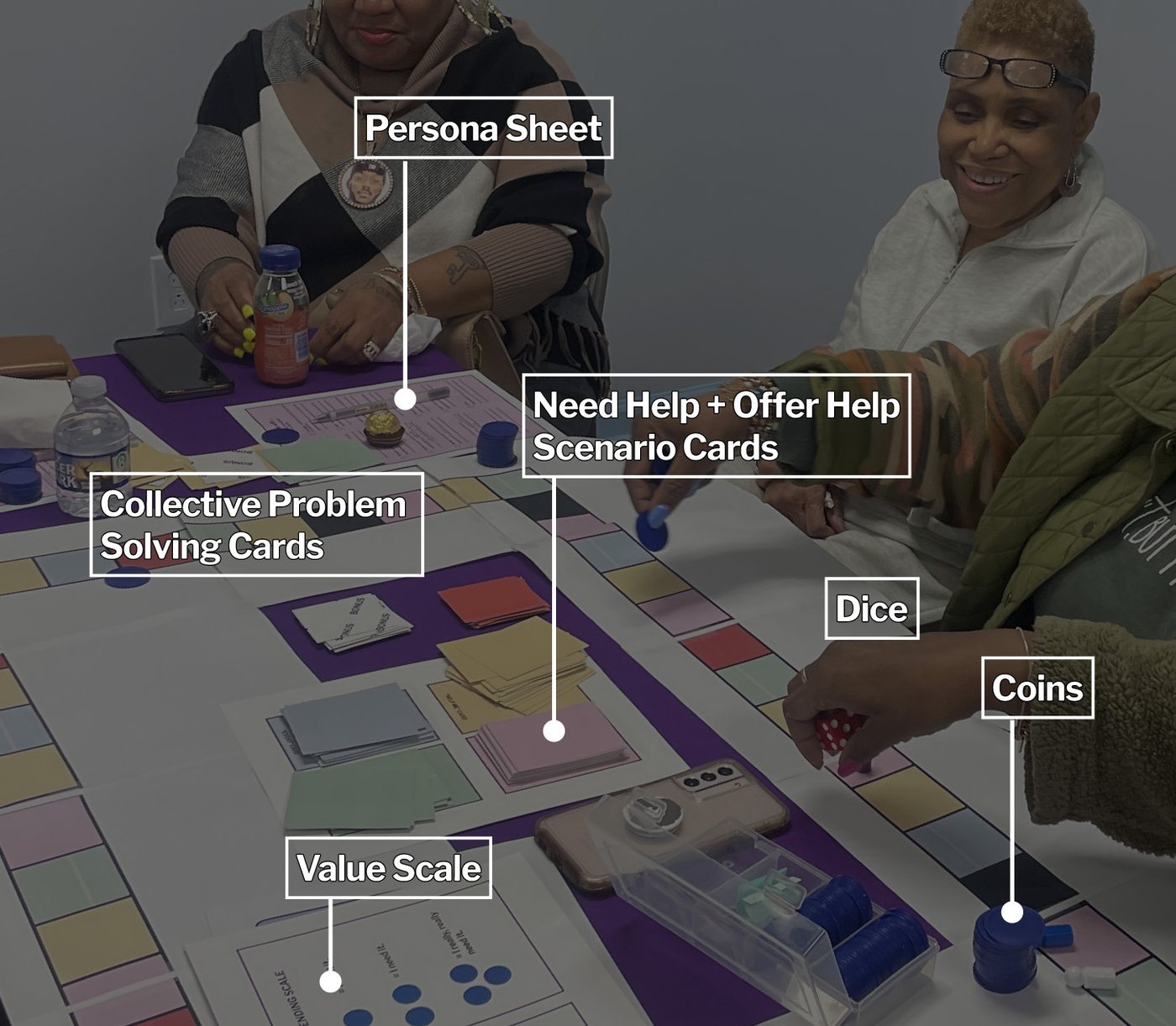
Each player builds a character that guides their choices.
Players write 2 to 3 of each from their own life: what they need most, and what they can give.
Shared neighborhood challenges, events to support, and surprises.
The group decides together how much each act of help is worth.
The game ends when the whole community earns 50 coins. Nobody wins alone.
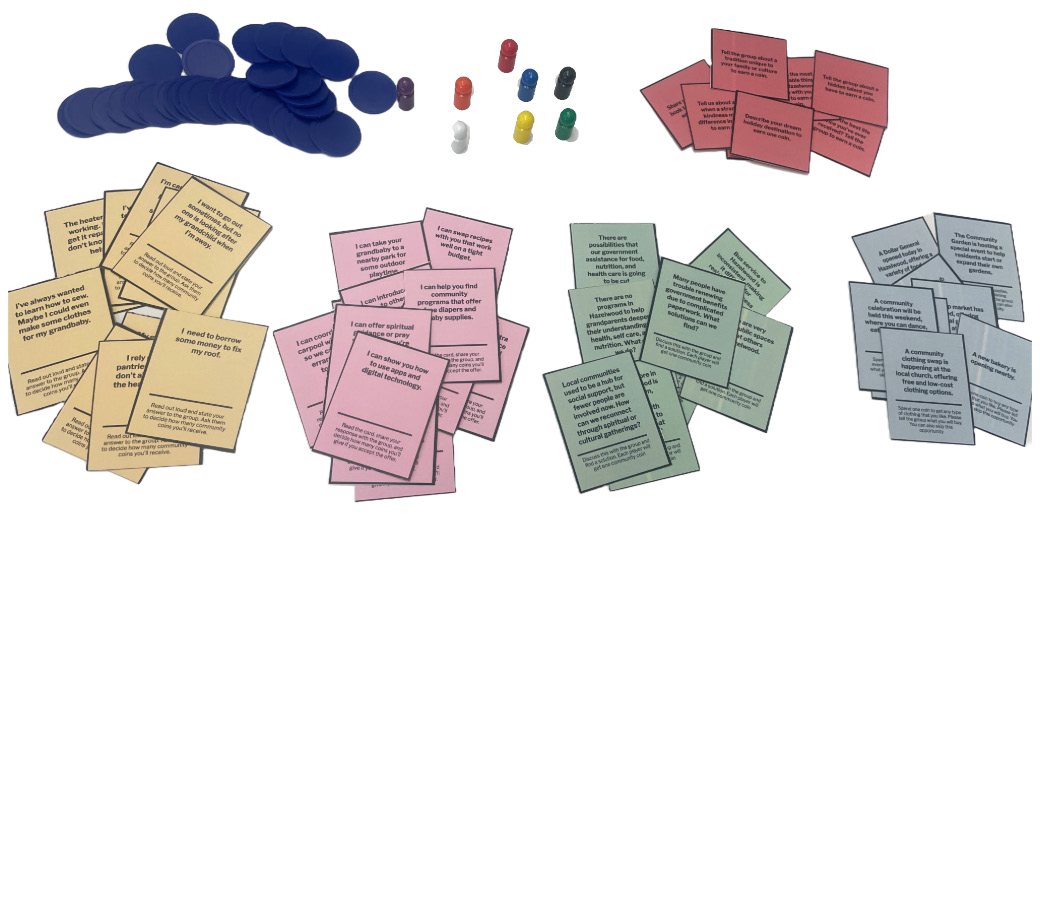
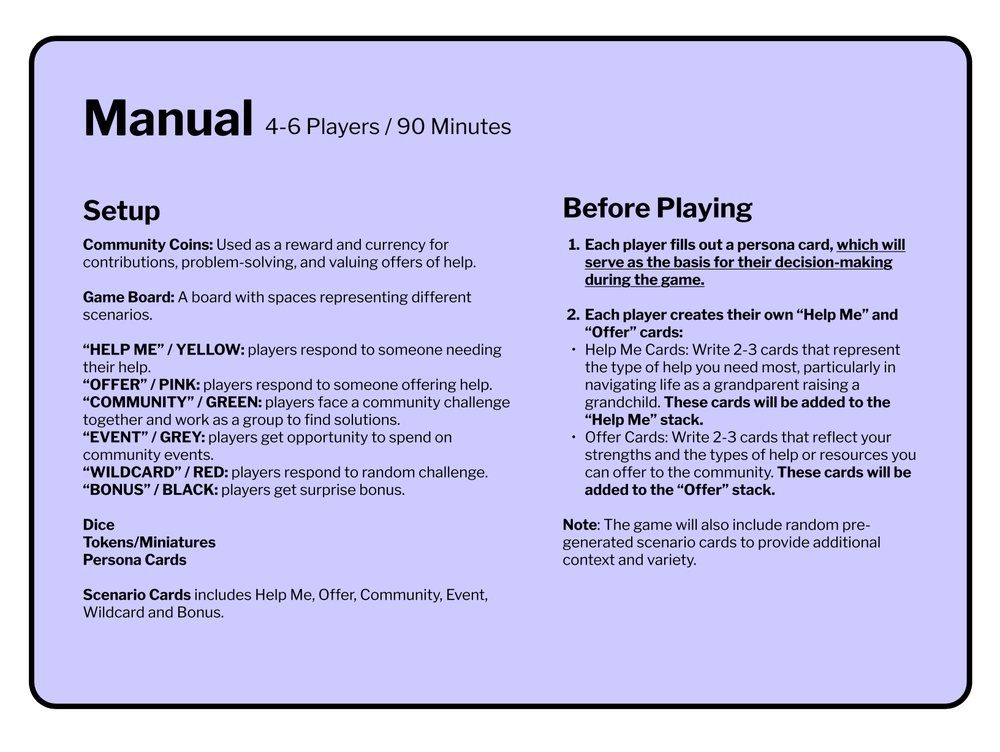
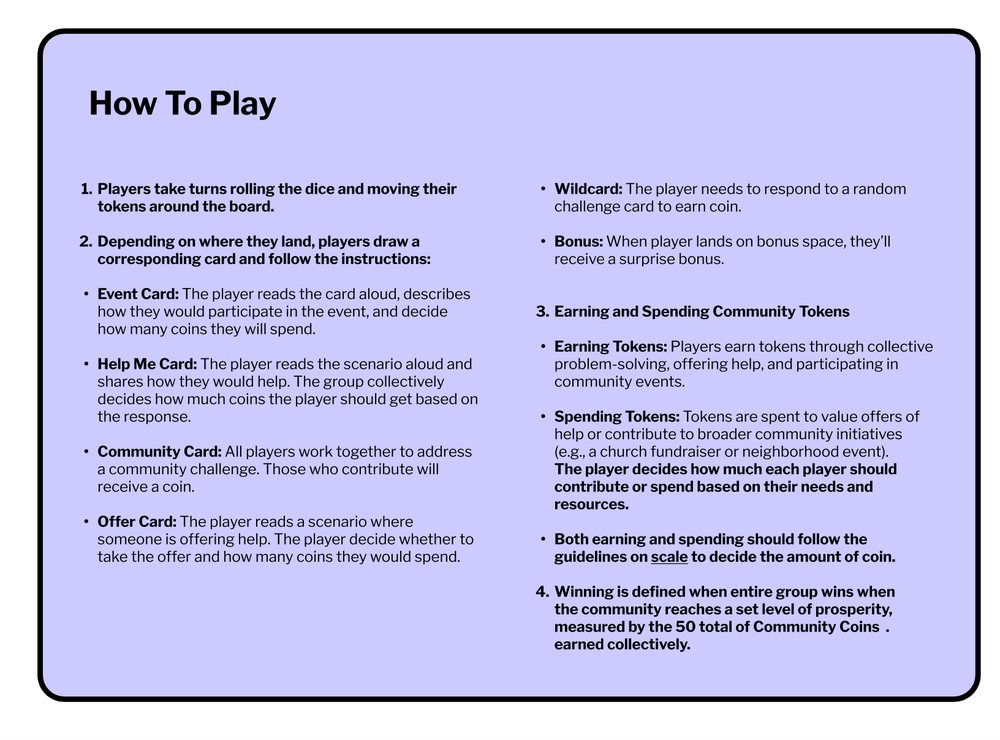
Game day at JADA House
Ten grandparents, all current or former primary caregivers, played for about an hour and a half, followed by a reflection on what a real support network could look like and what might get in its way.
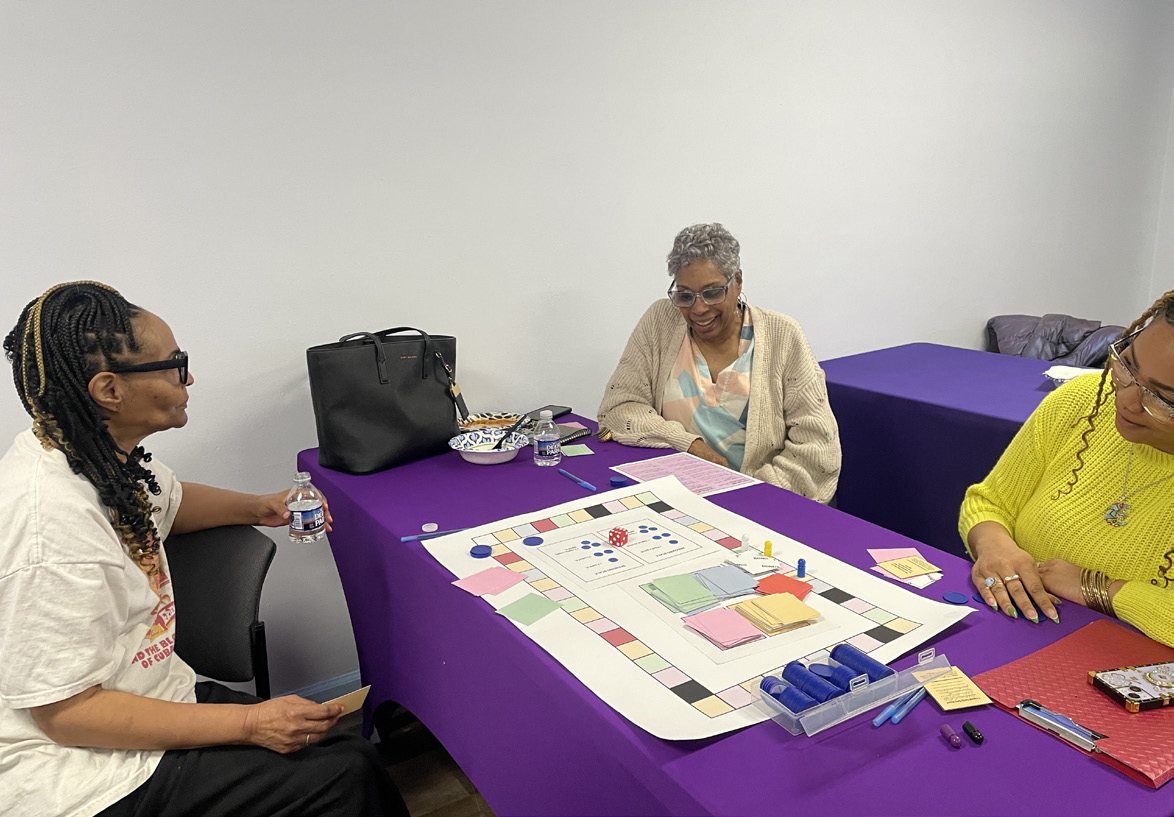
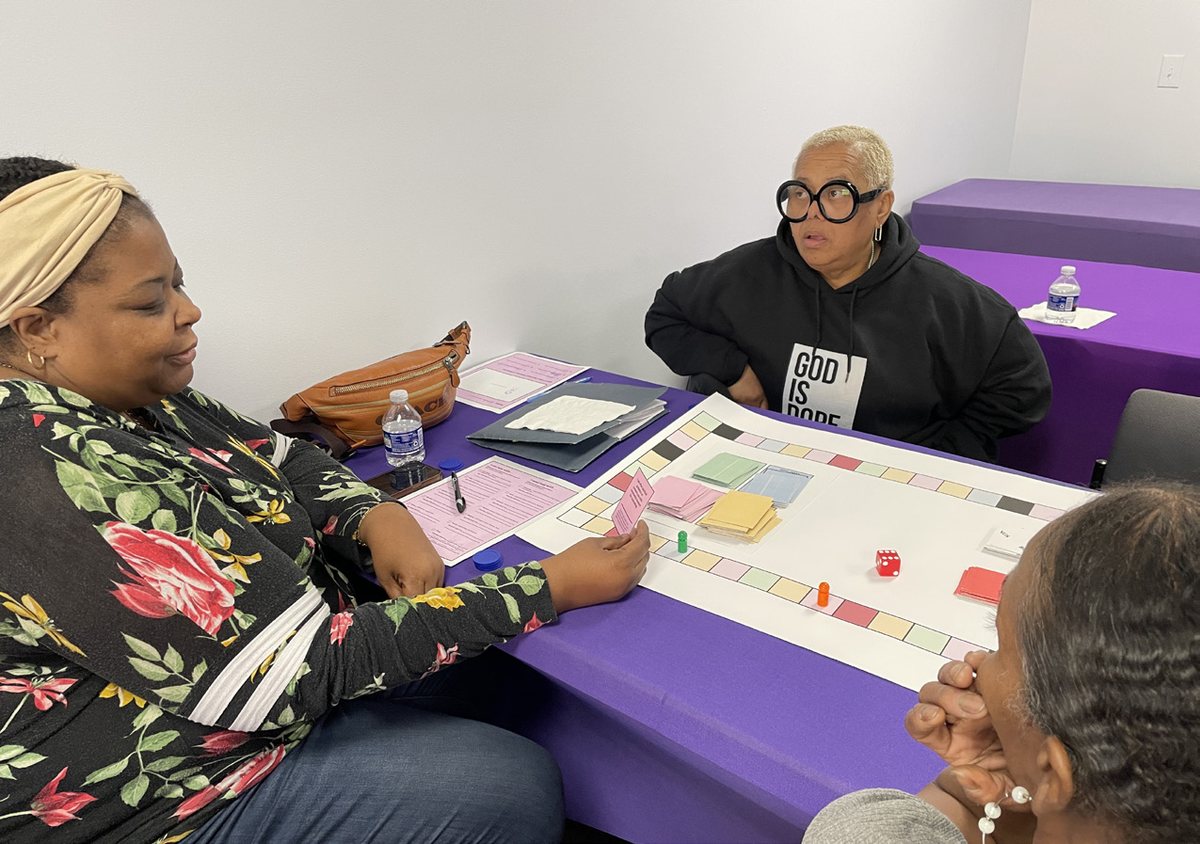
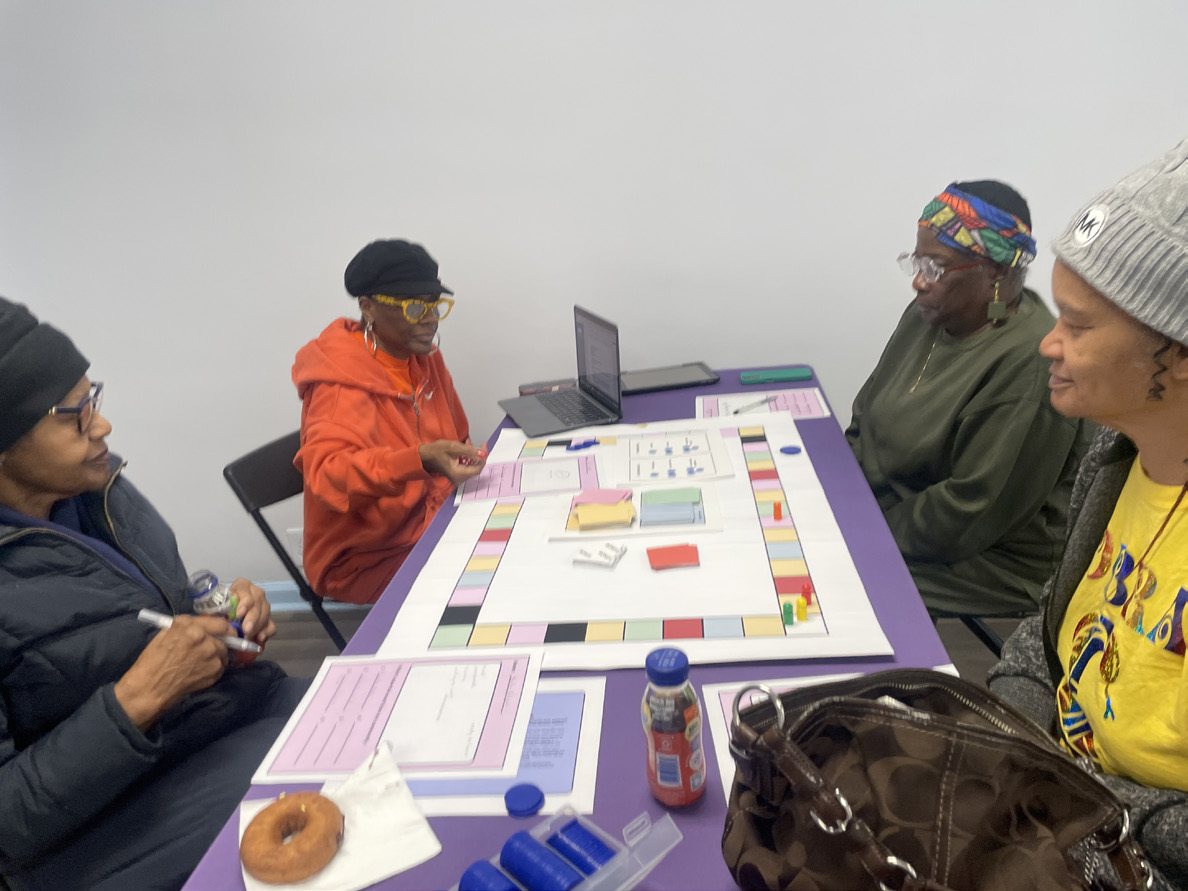
What the game revealed
"It's beautiful to know that everything I need is right here. Turns out, people want to help me."
"It's not about how big or perfect the help is, but about the thought and love behind it."
"It's not just about getting things done. It's about the trust and care we build and maintain."
"Everyone has a place and a role that feels right for them."
Five design principles
Kinship Co-Op: neighbors helping neighbors, on purpose
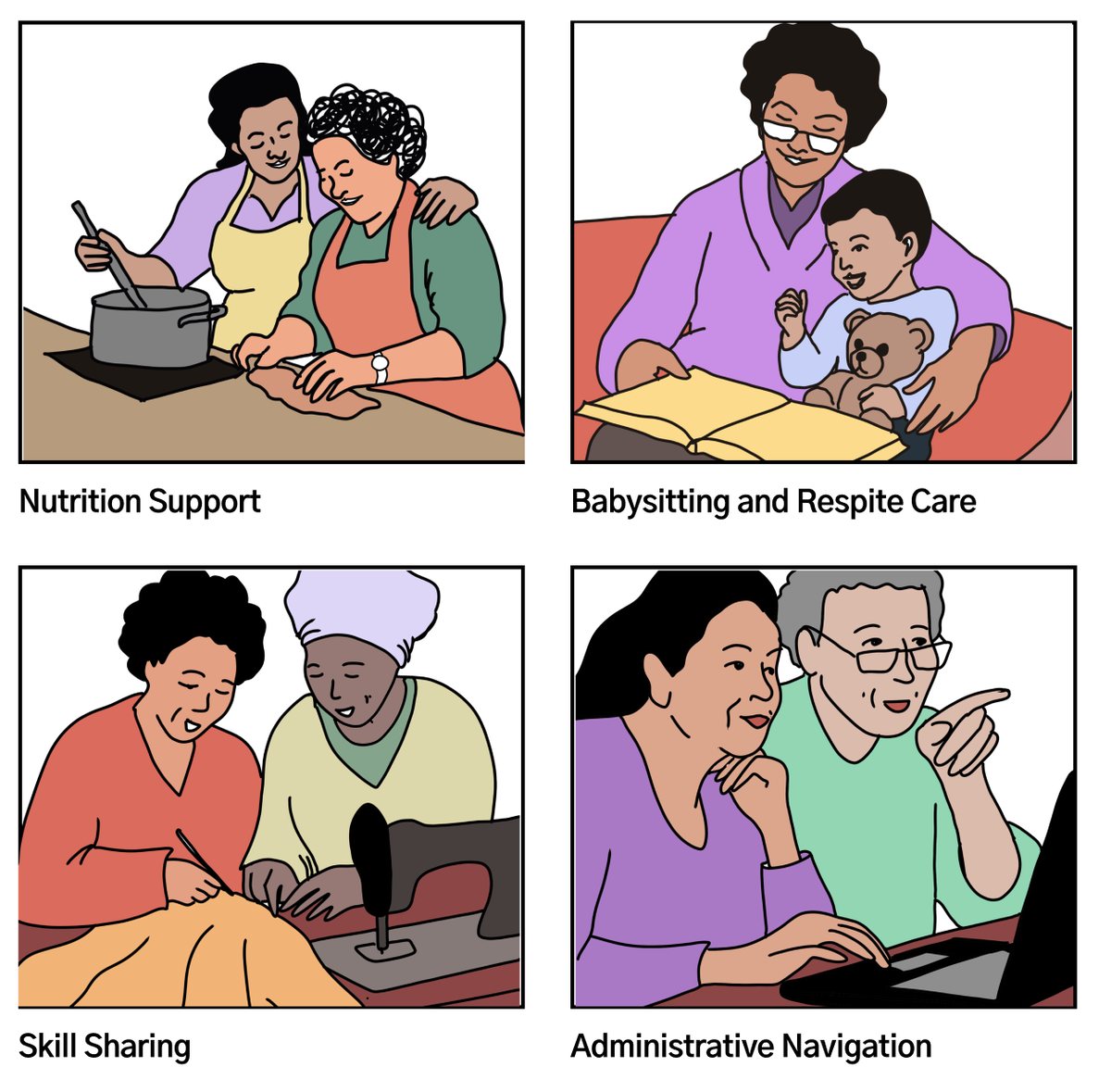
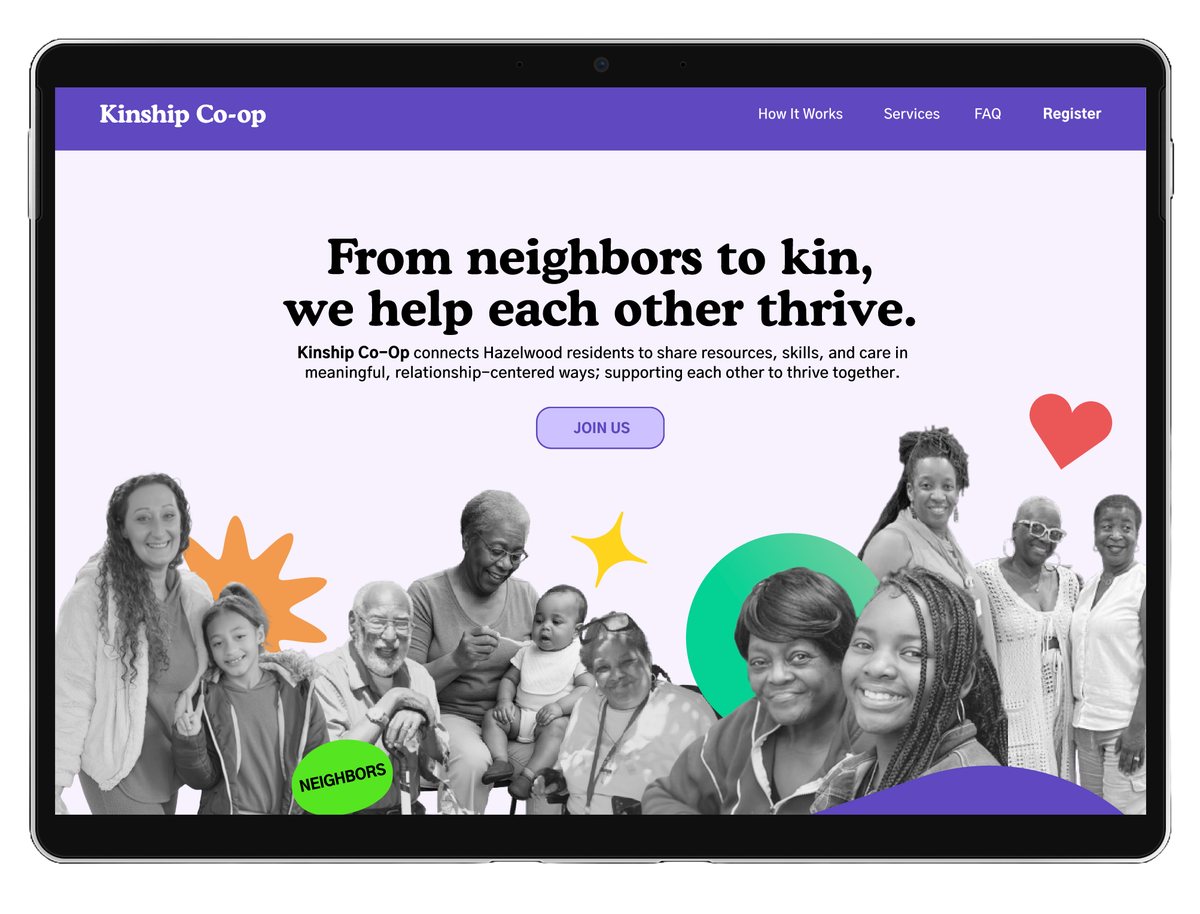
A member-led cooperative where grandparents ask for and offer everyday help, from babysitting to filling out SNAP forms. A trusted facilitator matches needs with helpers, and the Co-Op links members to churches, food programs and local organizations that already exist.
What members exchange
- Respite care and babysitting
- Nutrition and cooking support
- Rides to appointments and stores
- Emotional and spiritual companionship
- Help with SNAP, WIC and paperwork
- Skill sharing across generations
- Borrowing and lending everyday items
Four rotating roles, no permanent boss
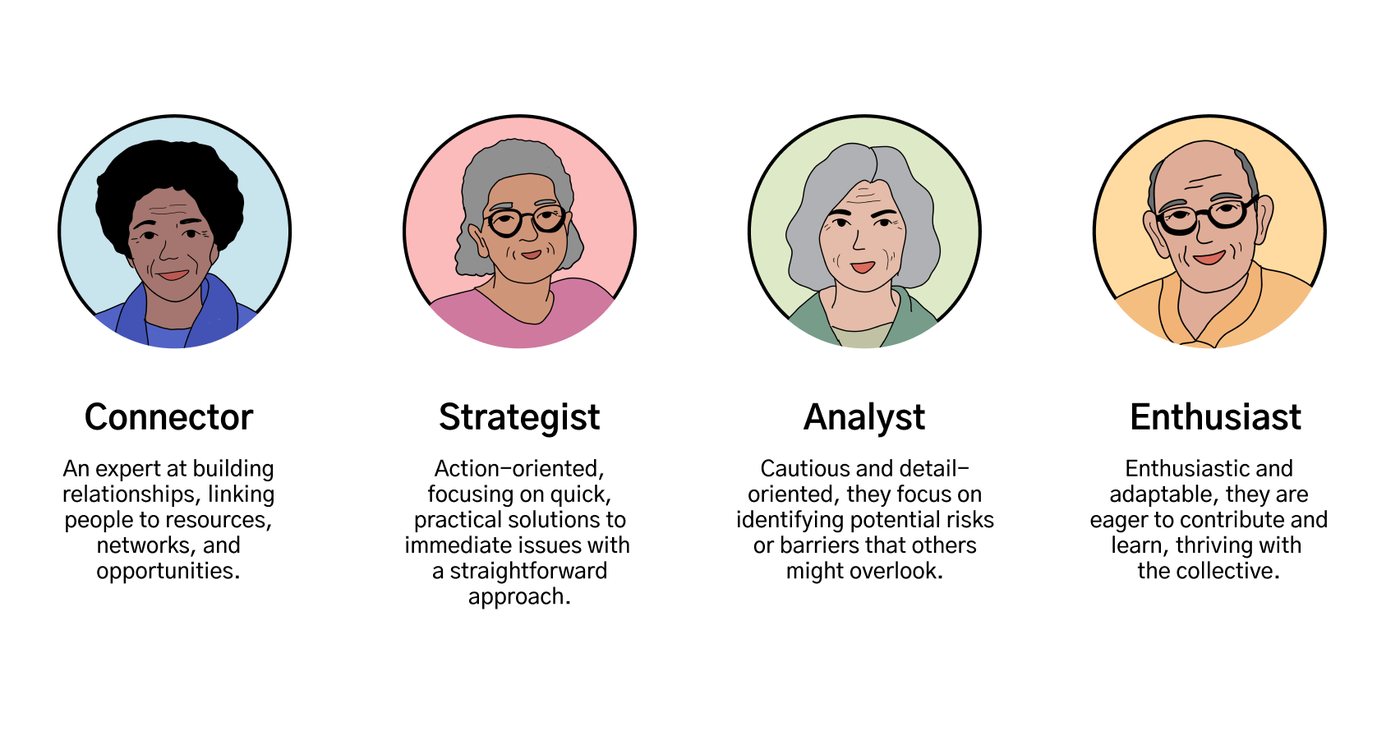
Outreach and networking: bring in new members and partners.
Resource management: run exchanges and emergency requests.
Internal engagement: onboarding, meetups and celebrations.
Transparency and accountability: tracking, conflict resolution, reflection.
The service ecosystem
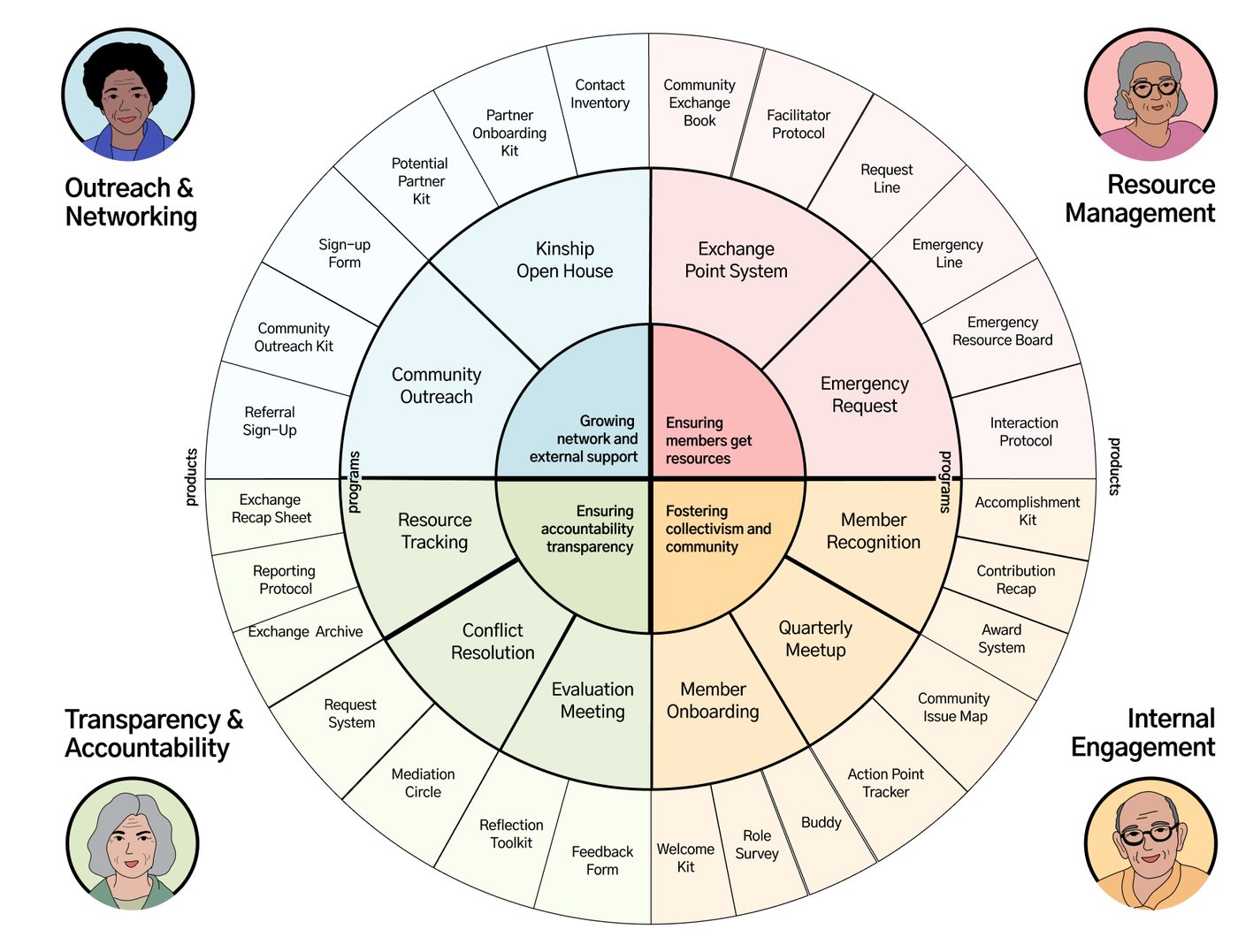
Each role owns one function, and each function has its own programs and tools, from the Exchange Book to the Welcome Kit. I mapped the whole service in a blueprint, below.
Jump to the service blueprintThe service blueprint
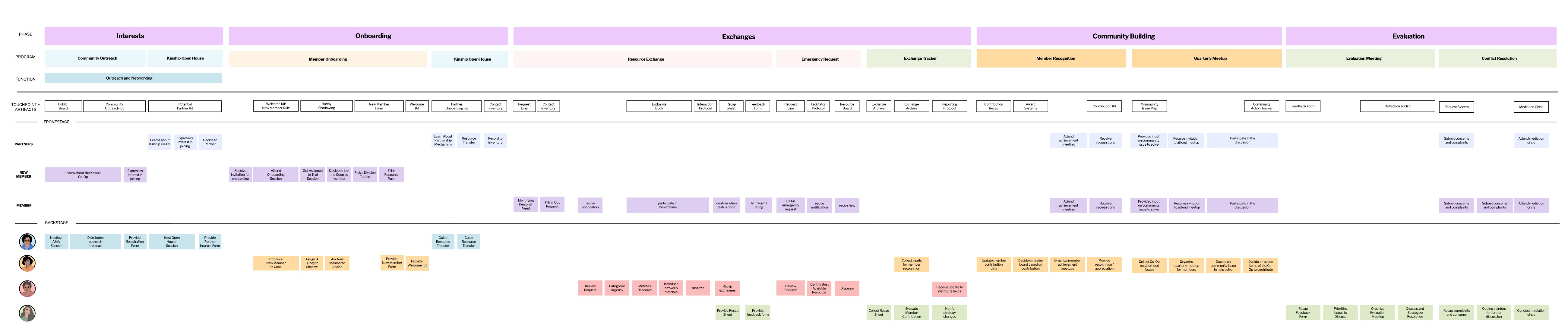
Five phases, from first hearing about the Co-Op to reflecting on how it's going: Interests, Onboarding, Exchanges, Community Building and Evaluation. For each step it shows what partners, new members and members see and do, and the backstage work carried by each of the four roles.
What changed after feedback
The first concept ran on a point system. In five evaluation sessions with JADA House, residents, CMU faculty, urbanists and existing co-ops, people worried points would make kindness feel like a transaction. So I put a trusted facilitator at the center of fairness instead, made the Co-Op a bridge to existing organizations rather than a new silo, and planned for it to grow beyond grandparents over time.
Paper over apps
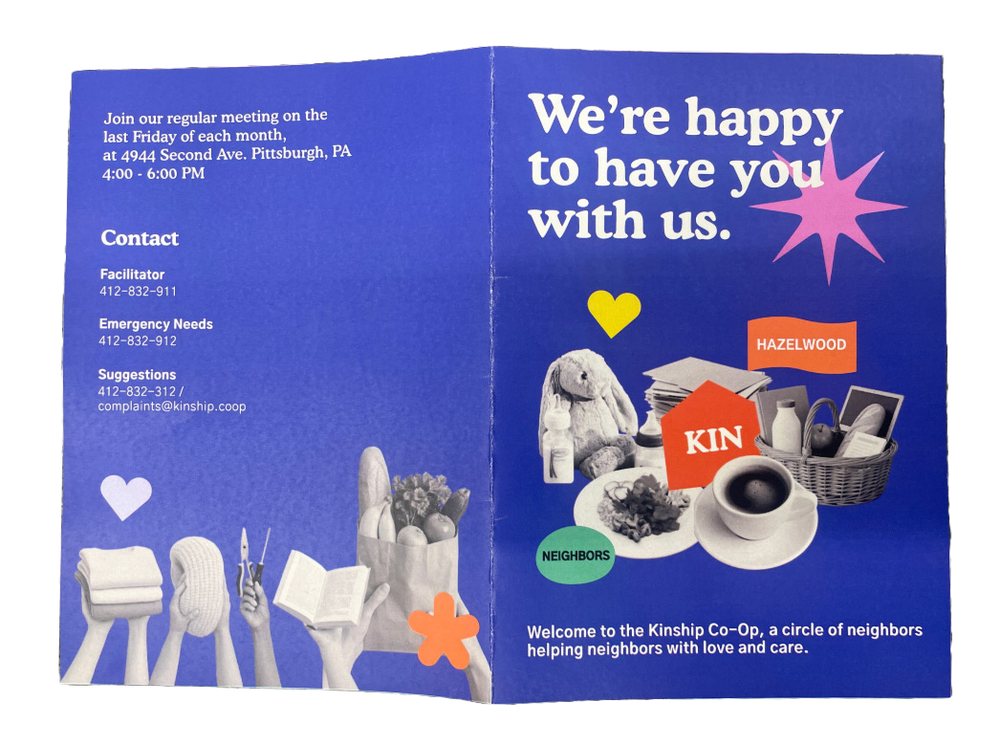
Grandmothers told me digital tools have a steep learning curve, so the core tools are physical, built with JADA House and tested with four volunteer grandparents.
The Exchange Book
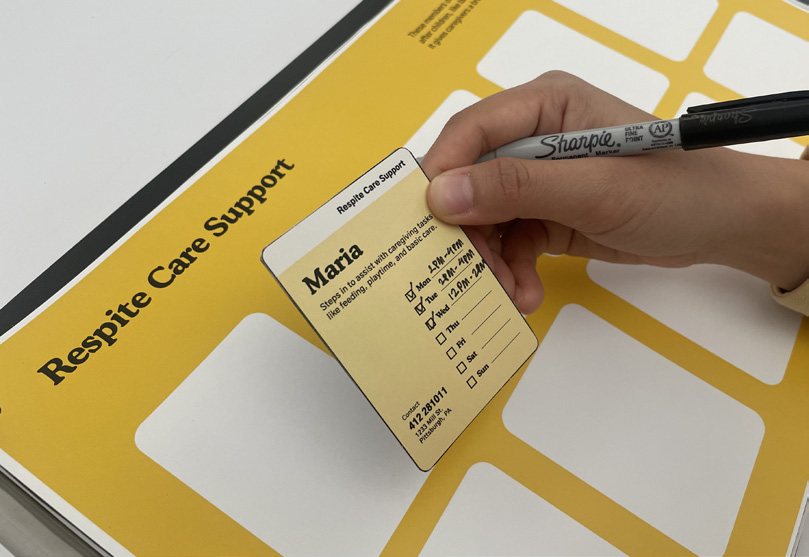
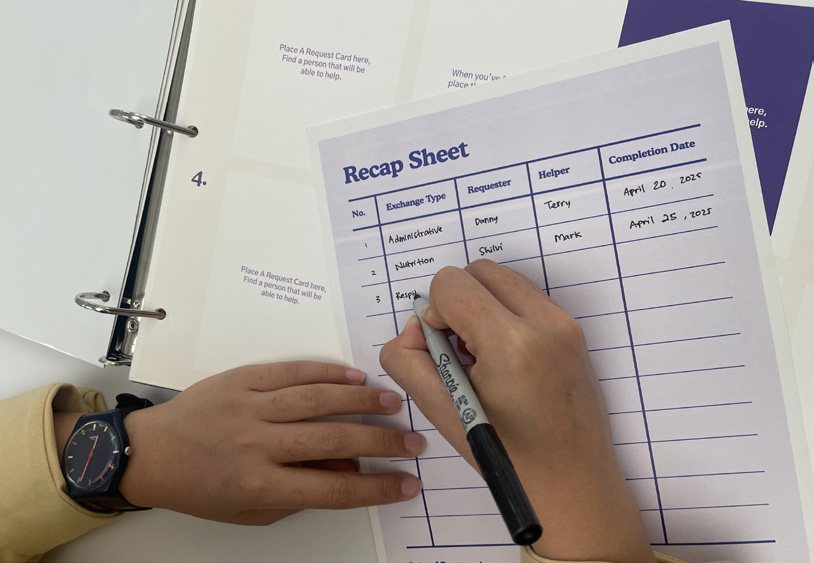
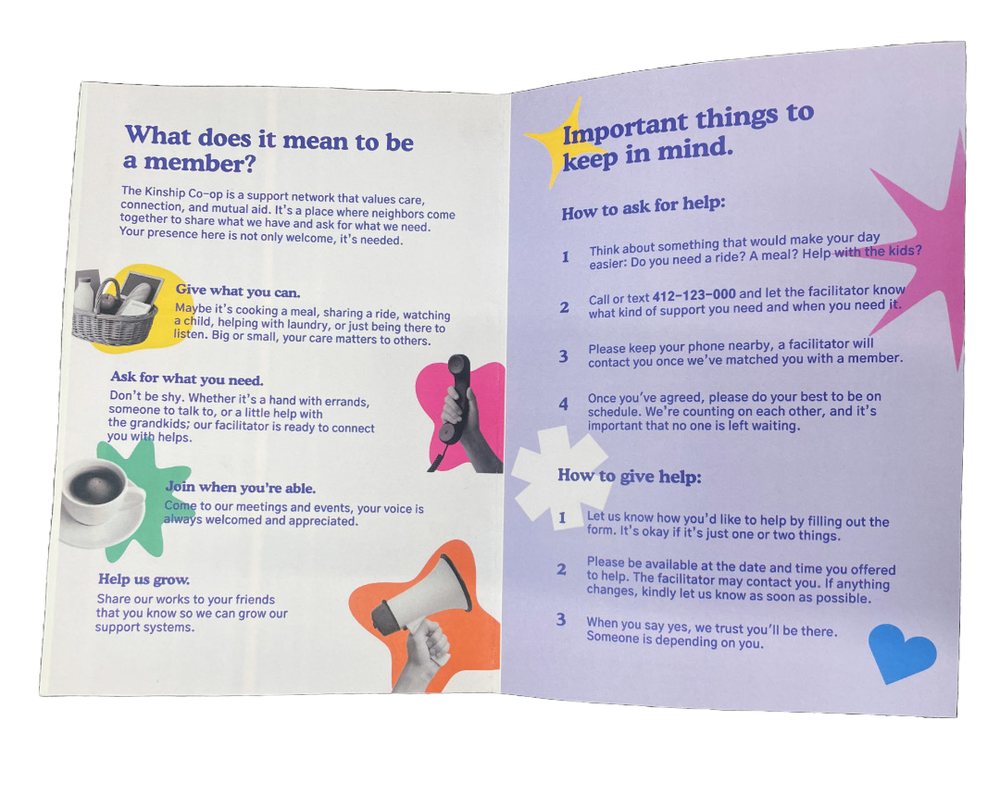
A binder the facilitator uses to run every exchange. A Request Card goes on the board, a matching Helper Card comes from the color-coded resource gallery, both move to "In progress" and then "Completed", and a recap sheet records what happened. Cards are magnetic so nothing gets lost.
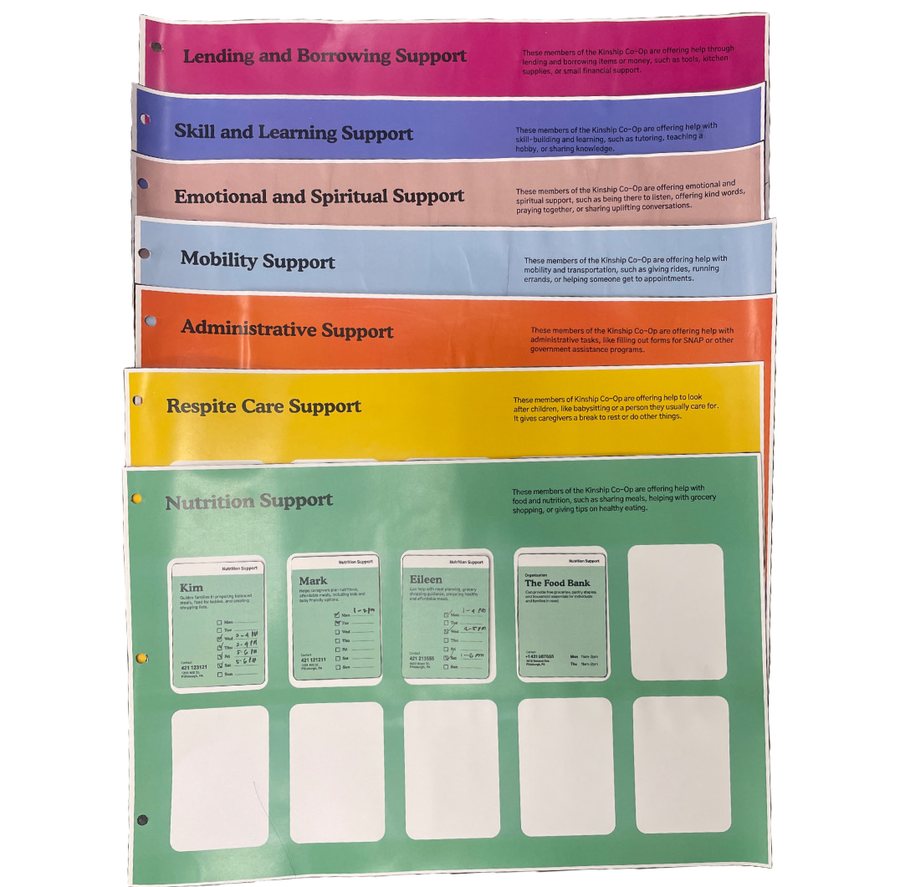
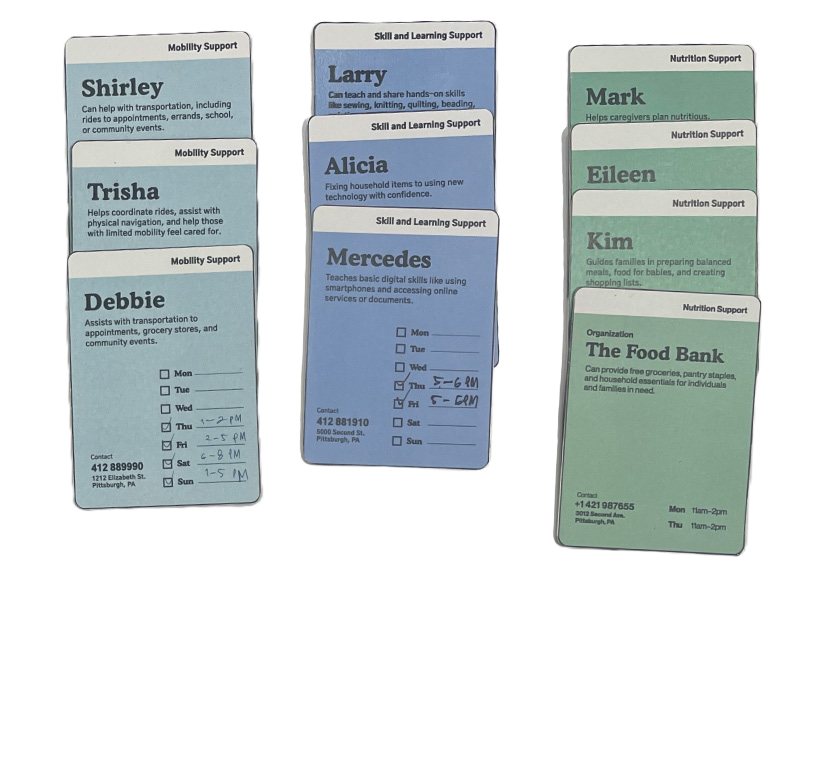
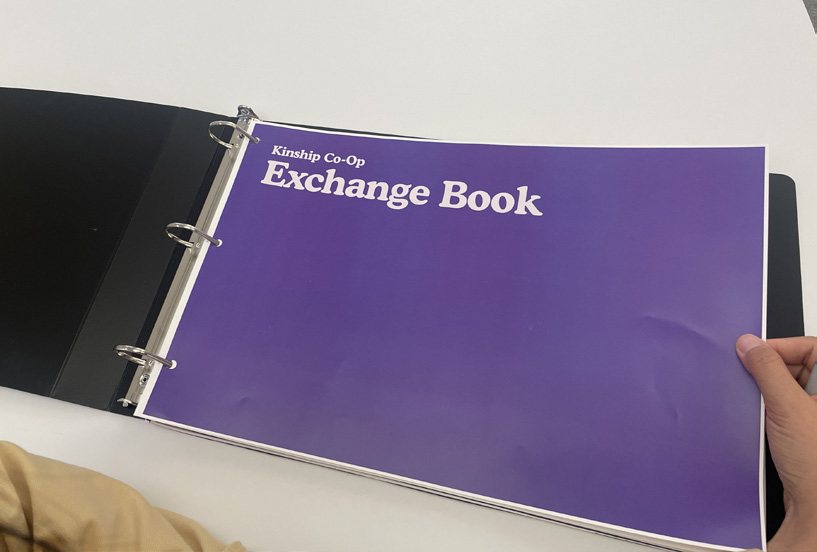
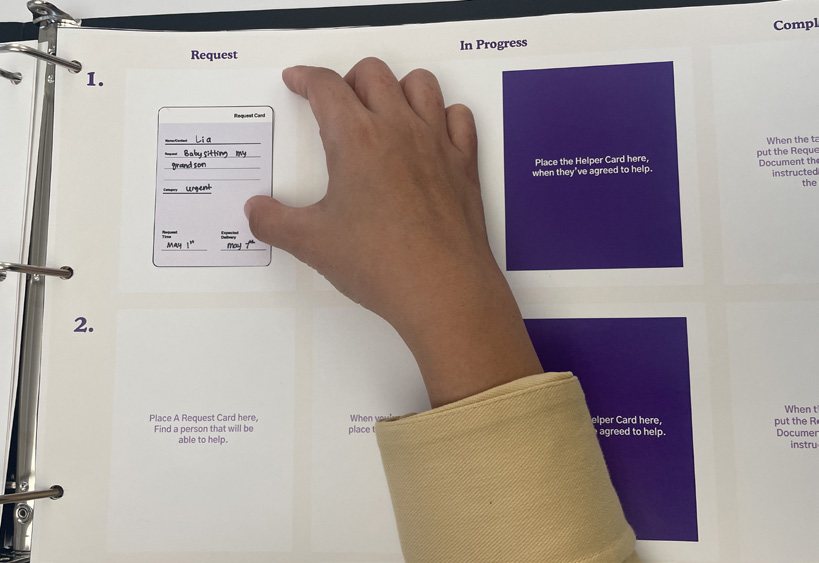
The interactive public board
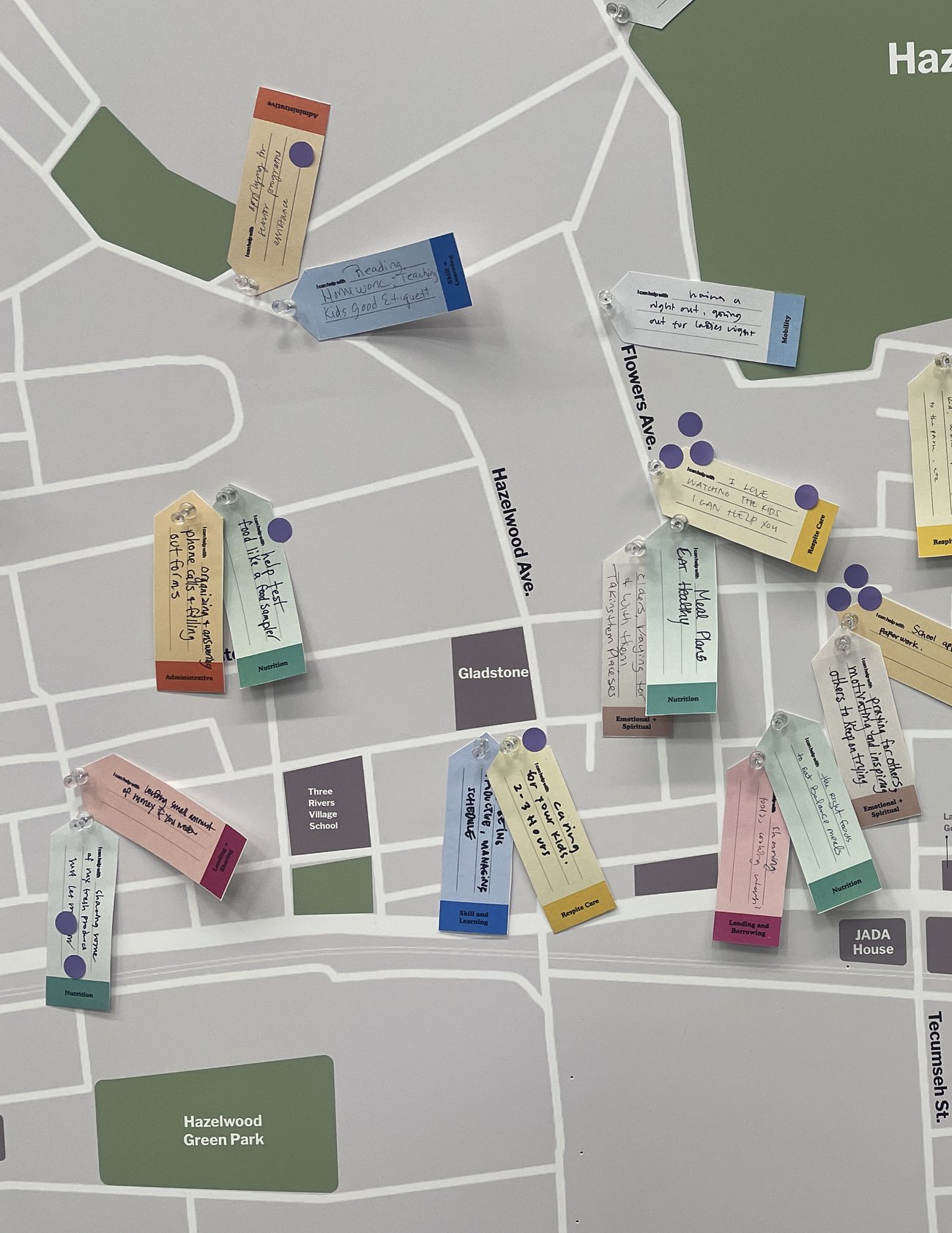
A low-barrier way for neighbors to discover the Co-Op in a familiar space. Testing changed it: some people were uncomfortable writing their needs in public, so I dropped that step, and the pieces became magnetic so they can be reused.
What testing changed in the book
- Bigger tabloid pages so the cards fit
- Larger cards that are easier to write on
- Magnetic paper for durability
- A new card type for community organizations, not just individuals
A seed, not a finished solution
Design alone can't fix food apartheid or caregiver fatigue. But it can make care visible and give people a structure to share it. Kinship Co-Op is a living framework, and I'm now turning it into a design toolkit so other neighborhoods can grow their own version.
Doing this work far from home, I was welcomed into kitchens, living rooms and long conversations. The grandmothers reminded me of my own grandmother, and of how much care quietly holds a community together.
Next: continue prototyping the service, keep testing with the Hazelwood community, and refine the tools.
Thank you
To Kristin Hughes for advising. To Terri Shields and Mercedes Williams at JADA House International, and the grandmothers of Hazelwood who shared their homes and stories. To the Family Center, Dylamato's Market and Hazelwood Initiative. And to the GuSH Research Grant and LPDP for supporting this work.
Back to all work